Geogrids are widely used in pavement and ground reinforcement to improve load distribution, reduce rutting, and extend service life. Among the most common options are biaxial geogrids vs triaxial geogrids. While both improve pavement performance, they function differently and are not interchangeable in all situations.
A frequent engineering question is:
When should triaxial geogrid be used instead of biaxial geogrid?
This article provides a detailed, engineering-based comparison of triaxial geogrid vs biaxial geogrid, focusing on structural behavior, load transfer mechanisms, and real-world application scenarios to help you make the correct design choice.
1. Understanding the Role of Geogrids in Pavement Systems
In pavement structures, geogrids are used to:
- Improve load distribution
- Increase apparent stiffness of aggregate layers
- Limit lateral movement of aggregates
- Reduce rutting under repeated traffic loads
- Extend pavement service life
The effectiveness of a geogrid depends not only on tensile strength, but also on aperture geometry and load transfer directionality.
2. What Is a Biaxial Geogrid?
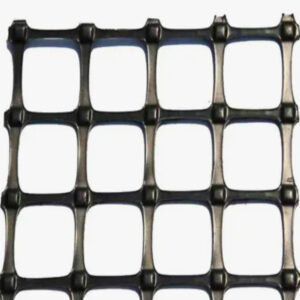
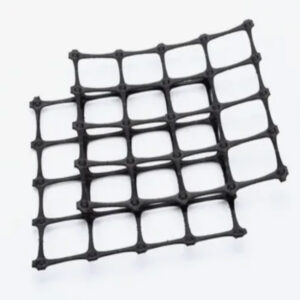
A biaxial geogrid is a two-dimensional polymer grid with high tensile strength in two perpendicular directions (machine direction and cross-machine direction).
Key Characteristics of Biaxial Geogrid
- Rectangular or square apertures
- Strength aligned in two main axes
- Efficient aggregate interlock
- Proven performance in conventional pavements
Biaxial geogrids are typically manufactured from PP or PET and are widely standardized in road design.
3. What Is a Triaxial Geogrid?
A triaxial geogrid features a triangular aperture geometry designed to provide near-isotropic stiffness and strength in multiple directions.
Key Characteristics of Triaxial Geogrid
- Triangular or hexagonal aperture structure
- Load distribution in radial directions
- Improved confinement under multi-directional loading
- Enhanced stiffness at small strains
Triaxial geogrids were developed specifically to address limitations of traditional biaxial systems under complex traffic loading.
4. Load Transfer Mechanism: Triaxial vs Biaxial Geogrid
Biaxial Geogrid Load Transfer
- Load transfer primarily along two orthogonal axes
- Aggregate interlock effective along grid ribs
- Best performance when traffic direction is predictable
Triaxial Geogrid Load Transfer
- Load transferred radially in multiple directions
- Uniform confinement of aggregate
- More efficient stress redistribution
👉 Engineering Insight:
When loads are applied from varying directions, triaxial geogrids provide more uniform reinforcement.

5. Traffic Directionality: A Key Selection Factor
One of the clearest indicators for choosing triaxial geogrid vs biaxial geogrid is traffic pattern.
Use Biaxial Geogrid When:
- Traffic flows in a dominant direction
- Loads are primarily linear
- Pavement geometry is uniform (straight roads)
Use Triaxial Geogrid When:
- Traffic loads are multi-directional
- Frequent turning, braking, or acceleration occurs
- Traffic direction cannot be predicted
Typical examples include intersections, roundabouts, and industrial yards.
6. Rutting Resistance and Aggregate Confinement
Biaxial Geogrid
- Effective in controlling rutting under straight-line traffic
- Requires good aggregate quality and compaction
- Performance depends on alignment with load direction
Triaxial Geogrid
- Superior confinement due to triangular geometry
- Improved rut resistance under dynamic and random loads
- More forgiving of construction variability
For high-stress pavement zones, triaxial geogrids often outperform biaxial geogrids.
7. Subgrade Strength Considerations
On Moderate to Good Subgrades
- Biaxial geogrids provide sufficient reinforcement
- Cost-effective and easy to install
On Weak or Variable Subgrades
- Triaxial geogrids distribute loads more evenly
- Reduce stress concentrations
- Improve performance consistency
While both can be used on weak soils, triaxial geogrids provide greater reliability in non-uniform conditions.
8. Pavement Thickness Reduction Potential
One advantage of geogrid reinforcement is the ability to reduce aggregate thickness.
- Biaxial geogrids: moderate thickness reduction
- Triaxial geogrids: greater stiffness at small strains → better thickness optimization
In heavily trafficked areas, triaxial geogrids often enable greater material savings over the pavement life cycle.
9. Construction Tolerance and Installation Robustness
Biaxial Geogrid
- Sensitive to orientation
- Must be aligned correctly with traffic direction
- Performance depends on proper placement
Triaxial Geogrid
- Orientation-independent
- Easier installation in irregular areas
- Lower risk of installation errors
For complex layouts, triaxial geogrids reduce construction risk.
10. Typical Applications Comparison
Applications Best Suited for Triaxial Geogrid
- Intersections and junctions
- Roundabouts
- Port and container yards
- Airport aprons and taxiways
- Industrial hardstands
- Parking areas with turning vehicles
Applications Best Suited for Biaxial Geogrid
- Straight road sections
- Highway base and subbase layers
- Rural and low-volume roads
- Temporary access roads
11. Cost vs Performance Analysis
Material Cost
- Triaxial geogrid: higher unit cost
- Biaxial geogrid: lower unit cost
System Cost
- Triaxial geogrid often reduces aggregate thickness and maintenance
- Biaxial geogrid remains economical for simple pavement structures
👉 Design Principle:
Choose based on total system performance, not material price alone.
12. Durability and Long-Term Performance
Both triaxial and biaxial geogrids:
- Are resistant to chemical degradation
- Perform well under cyclic loading
- Offer long design life
However, triaxial geogrids maintain performance more consistently under complex loading patterns.
13. Can Triaxial and Biaxial Geogrids Be Used Together?
Yes. A common practice is:
- Triaxial geogrid in high-stress zones (intersections, curves)
- Biaxial geogrid in straight sections
This hybrid approach optimizes cost and performance.
14. Design Selection Summary Table
| Design Condition | Recommended Choice |
|---|---|
| Multi-directional traffic | Triaxial geogrid |
| Turning and braking loads | Triaxial geogrid |
| Straight roads | Biaxial geogrid |
| Cost-sensitive projects | Biaxial geogrid |
| Complex geometry | Triaxial geogrid |
| Uniform load direction | Biaxial geogrid |
15. Final Conclusion
So, when should triaxial geogrid be used instead of biaxial geogrid?
✔ Choose triaxial geogrid when traffic loads are multi-directional, unpredictable, or highly concentrated.
✔ Choose biaxial geogrid when loads are primarily linear and pavement geometry is simple.
In summary:
- Triaxial geogrids excel in complex, high-stress pavement zones
- Biaxial geogrids remain a cost-effective solution for standard road reinforcement
Correct selection between triaxial geogrid vs biaxial geogrid leads to longer pavement life, reduced maintenance, and optimized construction costs.