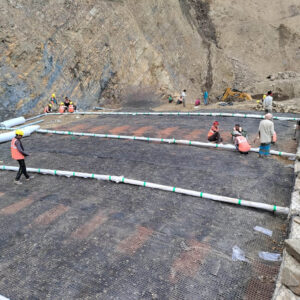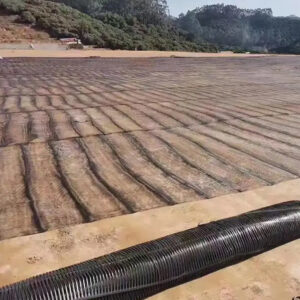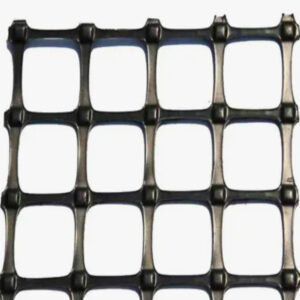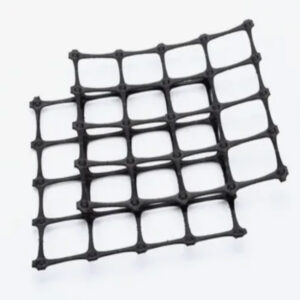
Effective drainage is fundamental to the long-term performance of roads, retaining walls, landfills, landscaping systems, and civil infrastructure. Poor drainage leads to hydrostatic pressure buildup, soil instability, pavement failure, and structural damage. For this reason, engineers increasingly rely on non-woven geotextile for drainage systems as a reliable filtration and separation solution.
This article provides a detailed engineering analysis of non-woven geotextile for drainage systems, including hydraulic performance, material structure, application methods, and selection guidelines.
Why Non-Woven Geotextile for Drainage Is Widely Used
Non-woven geotextile for drainage is manufactured through needle-punching or thermal bonding of polypropylene (PP) or polyester (PET) fibers. The randomly oriented fiber structure creates a highly permeable and flexible filtration medium.
Key advantages include:
- High water permeability
- Excellent soil filtration performance
- Strong puncture resistance
- Good elongation and adaptability
- Resistance to chemicals and biological degradation
Because of these properties, non-woven geotextile for drainage is widely adopted in both municipal and infrastructure projects.
How Non-Woven Geotextile for Drainage Systems Improves Filtration
The primary function of non-woven geotextile for drainage is filtration.
It allows water to pass through while retaining fine soil particles. This filtration process prevents soil migration into drainage aggregates or perforated pipes. Over time, a natural soil filter layer develops at the geotextile interface, enhancing long-term stability.
Without proper filtration, drainage layers can clog, reducing permeability and causing water accumulation. Non-woven geotextile for drainage systems ensures consistent water flow and protects drainage media from contamination.
Hydraulic Performance of Non-Woven Geotextile for Drainage Systems
Hydraulic performance is critical when evaluating non-woven geotextile for drainage systems.
1. Permeability and Permittivity
Non-woven geotextile offers high permittivity due to its three-dimensional fiber network. Water flows vertically through the material while soil particles are retained.
Higher permittivity values allow:
- Faster water discharge
- Reduced hydrostatic pressure
- Improved system efficiency
2. Apparent Opening Size (AOS)
AOS determines soil retention capacity. Proper AOS selection ensures compatibility with site soil gradation.
If AOS is too large, fine soil may pass through.
If AOS is too small, clogging may occur.
Therefore, soil analysis is essential when specifying non-woven geotextile for drainage systems.
Mechanical Properties of Non-Woven Geotextile for Drainage Systems
Although filtration is the main function, mechanical strength is equally important.
Non-woven geotextile for drainage systems provides:
- High elongation capacity
- Strong puncture resistance
- Good tear resistance
- Adaptability to uneven surfaces
These characteristics allow it to withstand aggregate placement and compaction during installation.
In heavy-load environments such as highways or landfill drainage layers, higher GSM non-woven geotextile for drainage systems is recommended.
Applications of Non-Woven Geotextile for Drainage
Road Subsurface Drainage
Non-woven geotextile for drainage systems is commonly installed in:
- French drains
- Edge drains
- Pavement base layers
It prevents fine soil intrusion into crushed stone drainage layers, maintaining long-term permeability.
Retaining Wall Drainage
Behind retaining walls, non-woven geotextile for drainage systems:
- Wraps drainage gravel
- Filters backfill soil
- Reduces hydrostatic pressure
This improves wall stability and prevents structural movement.
Landfill and Environmental Projects
In landfill drainage systems, non-woven geotextile for drainage systems serves as:
- A protective cushion layer
- A filtration layer for leachate collection systems
Its chemical resistance makes it suitable for aggressive environments.
Landscaping and Sports Fields
Non-woven geotextile for drainage systems enhances:
- Turf drainage
- Subgrade stability
- Soil erosion control
It is widely used in landscaping and recreational facilities.
GSM Selection for Non-Woven Geotextile for Drainage
Selecting the appropriate weight is essential for performance and durability.
General guidelines:
- 150–200 gsm: Light landscaping and garden drainage
- 200–300 gsm: Road base and retaining wall drainage
- 300–500 gsm: Heavy-duty infrastructure and landfill systems
Higher GSM non-woven geotextile for drainage systems provides improved puncture resistance and durability but may slightly reduce flexibility.
Proper engineering evaluation ensures optimal cost-performance balance.
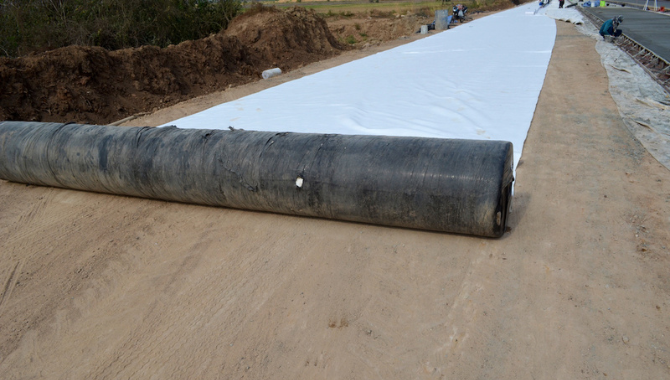
Installation Guidelines for Non-Woven Geotextile for Drainage
Correct installation directly affects drainage efficiency.
Important considerations:
- Prepare smooth subgrade surfaces
- Avoid wrinkles and folds
- Maintain adequate overlap (typically 300–500 mm)
- Protect from UV exposure before covering
- Carefully place aggregates to prevent puncture
When properly installed, non-woven geotextile for drainage systems performs reliably for decades.
Durability of Non-Woven Geotextile for Drainage
Durability is influenced by:
- Polymer type (PP or PET)
- Soil chemistry
- Load conditions
- UV exposure
High-quality non-woven geotextile for drainage systems offers:
- Excellent chemical resistance
- Resistance to biological degradation
- Long service life (20–50 years or more)
Once covered by soil or aggregate, UV degradation is minimal.
Comparison: Non-Woven Geotextile for Drainage vs Woven Geotextile
| Property | Non-Woven Geotextile | Woven Geotextile |
|---|---|---|
| Filtration | Excellent | Moderate |
| Permeability | High | Lower |
| Elongation | High | Low |
| Drainage Suitability | Ideal | Limited |
For drainage-specific applications, non-woven geotextile for drainage systems is generally preferred due to superior filtration capacity.
Common Design Mistakes When Using Non-Woven Geotextile
- Ignoring soil compatibility testing
- Selecting incorrect AOS
- Using insufficient GSM for heavy loads
- Poor overlap during installation
- Exposing material to prolonged UV radiation
Avoiding these mistakes ensures long-term performance.
Economic Benefits of Non-Woven Geotextile
Using non-woven geotextile for drainage systems reduces:
- Maintenance costs
- Drainage system failure risk
- Structural repair expenses
It extends infrastructure service life and improves project reliability.
The material offers a strong balance between performance and cost, making it a preferred solution in civil engineering projects worldwide.
Conclusion
Non-woven geotextile for drainage systems is an essential material in modern civil engineering. It delivers superior filtration, separation, and hydraulic performance while maintaining durability under load.
When correctly selected based on soil type, hydraulic requirements, and mechanical stress conditions, non-woven geotextile for drainage systems significantly enhances drainage efficiency and infrastructure longevity.
For roads, retaining walls, landfills, landscaping systems, and environmental protection projects, non-woven geotextile for drainage systems remains a proven, cost-effective, and technically reliable solution.