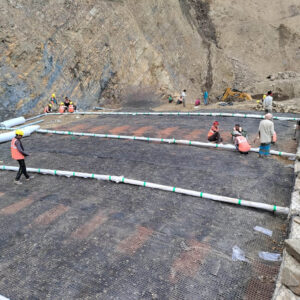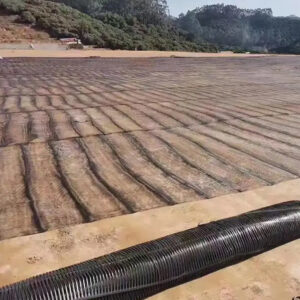
In modern civil engineering and infrastructure construction, speed, efficiency, and cost control are increasingly critical. While traditional poured concrete has long been the standard solution for lining, slope protection, and structural surfaces, cement blankets (also known as concrete canvas or concrete cloth) have emerged as an innovative alternative.
This article provides a detailed comparison of cement blanket vs traditional concrete, examining installation methods, performance characteristics, cost implications, and application suitability to help engineers and decision-makers choose the right solution.
1️⃣ What Is a Cement Blanket?
A cement blanket is a flexible, fabric-based composite impregnated with a dry cement mixture. It typically consists of:
- A cementitious core
- A reinforcing fiber matrix
- A waterproof backing membrane
Once unrolled and hydrated with water, the cement blanket hardens to form a thin, durable concrete layer.
Key characteristics:
- Supplied in rolls
- Requires only water to cure
- Sets rapidly (initial set within hours)
- Minimal equipment required
2️⃣ What Is Traditional Concrete?
Traditional concrete is produced by mixing cement, aggregates, water, and sometimes admixtures. It requires:
- Batch mixing (on-site or ready-mix)
- Formwork
- Steel reinforcement (often)
- Skilled labor for placement and finishing
- Extended curing time
Traditional concrete remains the primary choice for structural applications but involves more complex construction processes.
3️⃣ Installation Process: Cement Blanket vs Traditional Concrete
Cement Blanket Installation
✔ Minimal site preparation
✔ Unroll material over surface
✔ Anchor edges
✔ Hydrate with water
✔ No formwork or mixing required
Installation is fast and can be completed by small teams, even in remote locations.
Traditional Concrete Installation
❌ Formwork construction
❌ Concrete mixing or delivery
❌ Placement and vibration
❌ Surface finishing
❌ Extended curing period
The process is labor-intensive and highly dependent on weather and site conditions.
4️⃣ Construction Speed and Labor Requirements
| Aspect | Cement Blanket | Traditional Concrete |
|---|---|---|
| Installation speed | Very fast | Slow |
| Labor demand | Low | High |
| Equipment needed | Minimal | Extensive |
| Skill level | Basic | Skilled trades required |
From a construction efficiency standpoint, cement blanket vs traditional concrete shows a clear advantage for cement blankets in time-sensitive projects.
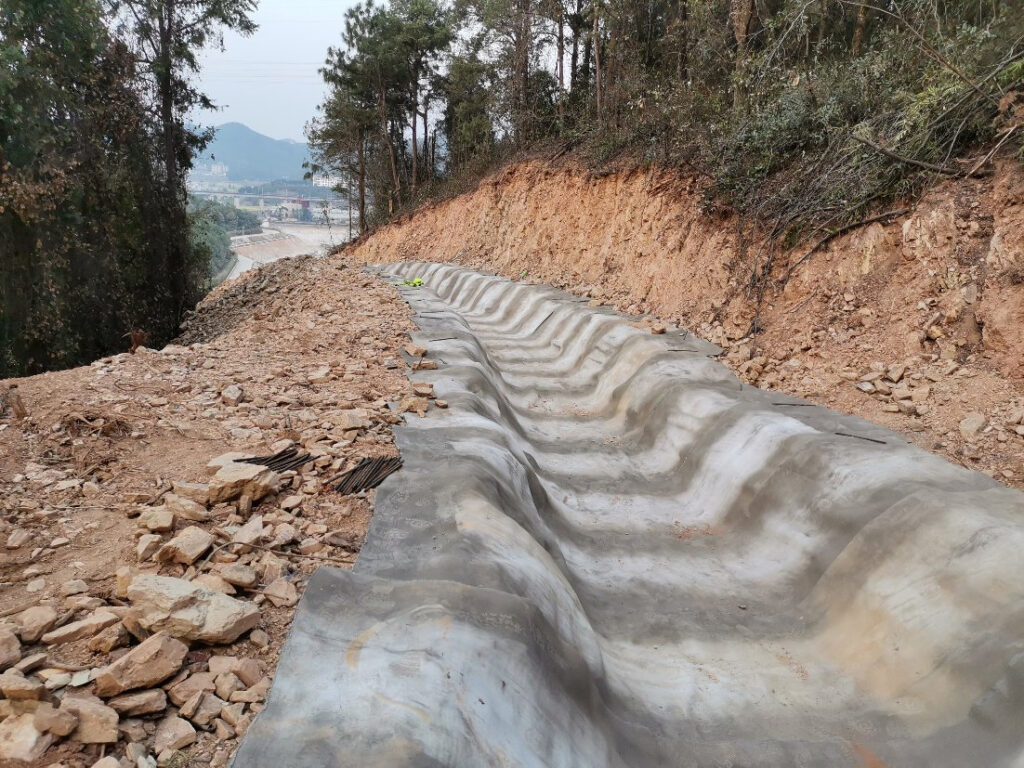
5️⃣ Thickness and Material Efficiency
- Cement blankets typically range from 5–13 mm in thickness
- Traditional concrete linings often exceed 75–100 mm
Despite being much thinner, cement blankets achieve sufficient strength for many non-structural applications, resulting in:
✔ Lower material usage
✔ Reduced transport costs
✔ Less excavation and backfill
6️⃣ Structural and Mechanical Performance
Cement Blanket
- High early-age strength
- Good abrasion resistance
- Flexible before curing, rigid after setting
- Limited load-bearing capacity
Traditional Concrete
- Excellent compressive strength
- Suitable for heavy structural loads
- Can be reinforced for tensile strength
- Long-term durability in structural applications
For non-structural and lining applications, cement blankets perform exceptionally well. For load-bearing structures, traditional concrete remains essential.
7️⃣ Durability and Service Life
Cement blankets offer:
- High resistance to weathering
- Good chemical resistance
- Reduced cracking due to fiber reinforcement
Traditional concrete provides:
- Long service life
- High resistance when properly designed
- Potential cracking if curing or reinforcement is inadequate
In erosion control and lining projects, cement blankets often deliver sufficient durability with lower installation complexity.
8️⃣ Cost Comparison: Cement Blanket vs Traditional Concrete
Cement Blanket Cost Characteristics
✔ Higher material cost per square meter
✔ Lower labor and equipment costs
✔ Faster project completion
✔ Lower indirect costs
Traditional Concrete Cost Characteristics
✔ Lower raw material cost
❌ Higher labor costs
❌ Equipment and formwork expenses
❌ Longer construction schedules
In many small-to-medium projects, cement blanket vs traditional concrete results in lower total installed cost when indirect costs are considered.
9️⃣ Environmental and Sustainability Considerations
Cement blankets:
- Reduce concrete volume
- Minimize site disturbance
- Lower carbon footprint per installed area
- Suitable for remote and sensitive environments
Traditional concrete:
- High material consumption
- Larger environmental footprint
- Greater waste generation
From a sustainability perspective, cement blankets offer clear advantages in appropriate applications.
🔟 Typical Applications Comparison
Ideal Applications for Cement Blanket
- Drainage channels
- Ditches and culverts
- Slope and embankment protection
- Pipeline protection
- Temporary or rapid-deployment structures
- Remote or emergency works
Ideal Applications for Traditional Concrete
- Foundations
- Structural slabs
- Bridges and load-bearing walls
- Industrial floors
- High-load pavements
Understanding application suitability is critical when comparing cement blanket vs traditional concrete.
11️⃣ Performance Summary Table
| Criteria | Cement Blanket | Traditional Concrete |
|---|---|---|
| Installation speed | Excellent | Moderate to slow |
| Labor requirement | Low | High |
| Structural capacity | Limited | High |
| Thickness | Very thin | Thick |
| Flexibility | High (pre-cure) | Low |
| Suitability for remote sites | Excellent | Poor |
| Environmental impact | Lower | Higher |
🔟 Conclusion
When comparing cement blanket vs traditional concrete, the choice depends on project requirements rather than material superiority.
Choose cement blanket if you need:
✔ Rapid installation
✔ Minimal labor and equipment
✔ Thin concrete lining
✔ Cost control on small or remote projects
Choose traditional concrete if you need:
✔ Structural load-bearing capacity
✔ Long-term heavy-duty performance
✔ Reinforced structural elements
In erosion control, drainage, and slope protection projects, cement blankets provide a highly efficient and modern alternative to traditional concrete — delivering speed, simplicity, and reliable performance.