🧩 Cement Blanket vs Concrete: A Technical White Paper for Modern Infrastructure Applications
Abstract
Infrastructure engineers have long relied on traditional concrete for hydraulic engineering, slope protection, road repair, and channel lining. However, installation speed, environmental impact, and lifecycle costs have become increasingly important in recent construction specifications. The economy cement blanket, a cost-efficient type of Geosynthetic Cementitious Composite Mat (GCCM) supplied by Tynod, has emerged as a competitive replacement for cast-in-place concrete under specific conditions.
This white paper technically evaluates cement blanket vs concrete in terms of structure, engineering performance, hydraulic behavior, durability, sustainability, and practical installation considerations to help owners, engineers, and contractors make informed design decisions.
1️⃣ Introduction: Why Compare Cement Blanket vs Concrete?
Concrete is strong — but requires:
- Formwork
- Controlled curing conditions
- Skilled construction labor
- Extensive equipment
- Water supply and batching logistics
These dependencies create delays, high labor costs, and environmental disturbance.
The cement blanket, consisting of a dry cementitious layer bonded to geotextile reinforcement, activates simply by hydration. It provides a thin structural concrete layer capable of:
- Erosion control
- Surface protection
- Channel stabilization
- Slope defense
The question engineers now face:
Can an economy cement blanket deliver sufficient structural durability to replace conventional concrete?
The answer depends on application requirements — which this paper explores in detail.
2️⃣ Material Composition & Engineering Mechanisms
🏗 Cement Blanket Structure
Economy cement blankets typically consist of:
- Top surface: Nonwoven protective geotextile
- Middle layer: Dry cementitious powder (fiber-reinforced)
- Backing layer: Permeable geotextile for bonding to soil
- Optional PE or PVC coating for impermeable applications
Once hydrated, it cures into a thin concrete sheet supported by geosynthetic reinforcement.
🧱 Traditional Concrete Structure
Conventional concrete uses:
- Portland cement binder
- Sand and coarse aggregates
- Reinforcement (steel)
- Placing, compaction, vibration, curing
Concrete forms a solid monolithic mass with higher compressive strength but requires significant site work.
3️⃣ Mechanical Performance Comparison
| Property | Cement Blanket (Economy GCCM) | Traditional Concrete |
|---|---|---|
| Compressive Strength | Medium (25–35 MPa) | High (≥ 40 MPa typical) |
| Flexural Strength | Higher due to fiber reinforcement | Good but prone to cracking |
| Crack Resistance | Excellent due to geotextile and lower stiffness | Cracks easily under tension |
| Thickness | 5–15 mm typical | 80–200 mm for structural loads |
| Surface Integrity | Maintains even when cracked (reinforced fabric) | Cracks expand and propagate |
Key insight:
Cement blanket does not compete with structural concrete but excels in surface protection applications where distributed tension and crack control are critical.
4️⃣ Hydraulics, Erosion Control & Slope Stability Performance
Traditional concrete inhibits infiltration, causing runoff acceleration.
Cement blanket materials support:
- Surface erosion resistance to rainfall impact
- Channel lining without scouring
- Improved interface friction due to geotextile backing
Comparative Evaluation
| Engineering Performance | Cement Blanket | Concrete |
|---|---|---|
| Hydraulic Shear Resistance | High for moderate flows | Excellent for extreme flows |
| UV & Weather Durability | Good with proper coating | Excellent |
| Slip Resistance | Fiber-interlocked surface helps | Smooth surface may require texturing |
| Vegetation Compatibility | Semi-permeable options exist | Very limited |
➡ For slope re-vegetation, cement blankets perform significantly better.
5️⃣ Installation Requirements & Project Efficiency
🚧 Installation of Traditional Concrete
Requires:
- Earthwork & subgrade preparation
- Formwork construction
- Mixer trucks
- Vibrators & finishers
- Skilled labor crew
- Restricted working conditions (weather, moisture)
Delays are frequent.
⚙️ Installation of Tynod Economy Cement Blanket
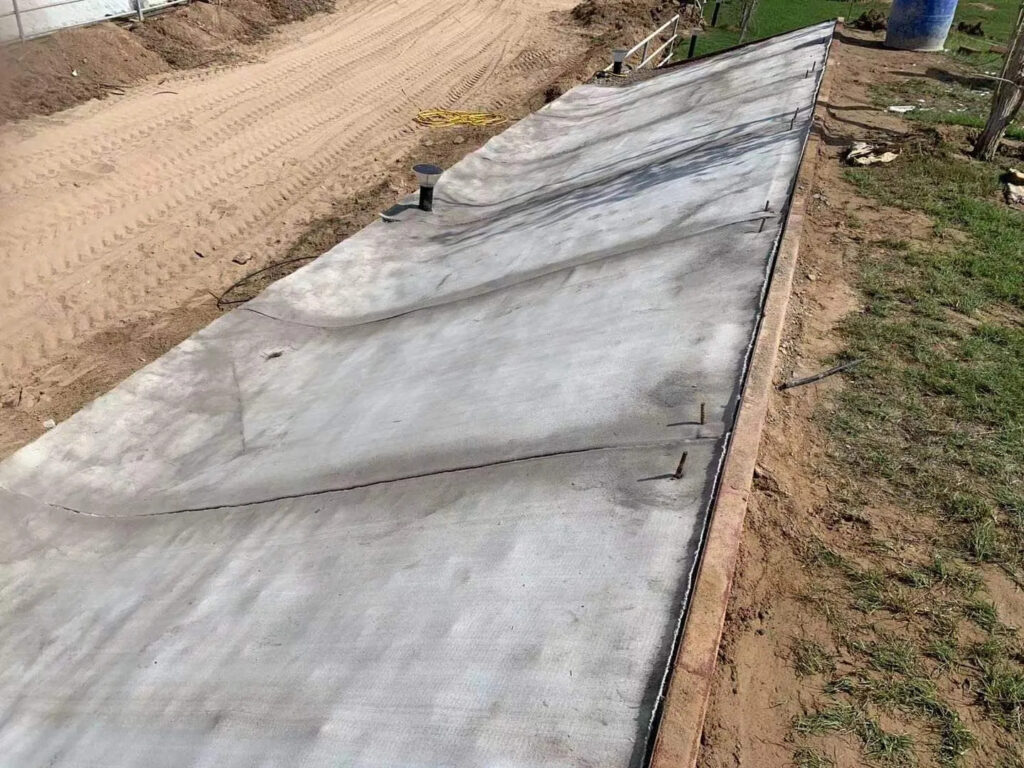
- Lightweight panels/rolls
- Roll out → Hydrate → Fix anchors → Done
- Cures within 24 hours
- Works on steep slopes easily
- Requires minimal equipment → reduce logistics costs
➡ Rapid deployment is the biggest advantage
especially in emergencies such as flood response or landslide remediation.
6️⃣ Environmental & Sustainability Impacts
Concrete has high carbon emissions due to cement production and transportation weight.
Cement blankets reduce:
- CO₂ footprint
- Water usage
- Land disturbance
- Vegetation destruction
Geotextile components provide improved soil bio-integration and can support natural restoration after stabilization.
📌 Useful for Low-Impact Development (LID) & environmental compliance.
7️⃣ Cost-Benefit & Lifecycle Comparison
| Cost Factor | Cement Blanket | Concrete |
|---|---|---|
| Initial Material Cost | Higher per m² | Lower per m² |
| Labor & Equipment Cost | Very low | Very high |
| Base Construction Cost | Reduced thickness = lower | Required deep base |
| Project Timing Cost | Minimal — quick reopening | Large indirect delays |
| Maintenance | Very low | Moderate to high |
➡ While concrete may appear cheaper per m², total project cost with concrete can be 40–60% higher due to labor and equipment.
8️⃣ Case Study Insights
Field projects show cement blankets thrive in:
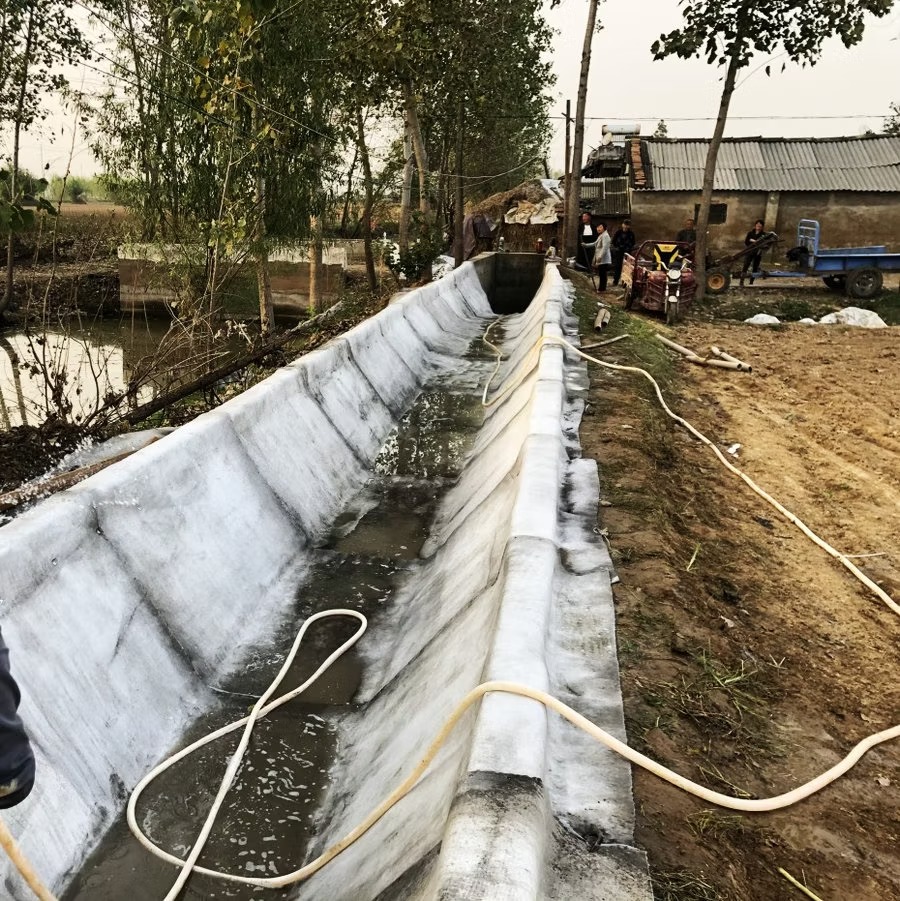
- Channel lining
- Landfill cover protection
- Coastal and riverbank scour mitigation
- Pipeline protection
- Water ditch stabilization
- Oil & gas facility erosion shields
- Mine tailings closure projects
Traditional concrete remains necessary when:
- Load-bearing structure is required
- Impact and abrasion forces exceed erosion thresholds
- Thick structural rigidity is needed
9️⃣ Engineering Design Considerations
| Design Parameter | Cement Blanket | Concrete |
|---|---|---|
| Self-weight Support | Good for soil/rock substrate | Needs strong foundation |
| Jointing Treatment | Overlap or mechanical fixing | Controlled expansion joints |
| Fire Resistance | Good after curing | Excellent |
| Chemical Exposure | Resistant with coating | May require additional protection |
➡ Engineers must evaluate flow class, expected hydraulic stress, and substrate stiffness.
🔟 Standards, Testing & Compliance
Economy cement blankets from Tynod comply with:
- ASTM D8364 — GCCM classification testing
- ASTM D1777 — thickness
- ASTM D8030 — compressive & flexural performance
- Hydraulic erosion resistance testing
- UV & aging durability requirements
Traditional concrete remains governed by:
- ACI/EN structural design codes
- Load and reinforcement specifications
➡ Cement blanket is validated as a protection layer, not a structural member.
🔚 Conclusion: When to Choose Cement Blanket vs Concrete
| Choose Cement Blanket When… | Choose Concrete When… |
|---|---|
| Rapid, mission-critical construction is required | The structure must support heavy loads |
| Slope protection or channel lining | High-strength pavements & mega-structures |
| Environmental impact must be minimized | Traditional aesthetics are needed |
| Construction area is restricted | Equipment access is easy |
| Skilled labor is limited | Long-term monolithic durability is required |
🌟 Final Engineering Verdict
Cement blanket is not a replacement for structural concrete
but is a superior solution to concrete in erosion protection and geotechnical surface applications.
🏆 Why Tynod Economy Cement Blanket?
- International manufacturing quality
- Cost-optimized formulation
- Strong geosynthetic reinforcement
- Flexible design for slope and hydraulic works
- Easy export logistics and rapid delivery
- Technical support for global contractors
📩 Contact Tynod today for product data sheets, pricing, and engineering support.