Introduction
Choosing the correct geotextile is a critical decision in geotechnical and civil engineering projects. One of the most common and important questions faced by engineers, contractors, and procurement professionals is how to choose between woven and non-woven geotextile. Although both materials fall under the same geosynthetic category, their structural characteristics, mechanical behavior, and functional performance differ significantly.
The comparison of woven vs non-woven geotextile is not simply a matter of preference or cost. Selecting the wrong type can result in inadequate soil separation, drainage failure, excessive deformation, or premature structural distress. Therefore, understanding how each geotextile works and where it performs best is essential for long-term project success.
This article provides an in-depth, engineering-focused analysis of woven vs non-woven geotextile. It explains their manufacturing processes, material properties, functional mechanisms, typical applications, and selection guidelines. The goal is to help decision-makers choose the right geotextile based on performance requirements rather than assumptions.
What Is a Geotextile?
A geotextile is a permeable synthetic fabric placed in contact with soil, rock, or aggregate to perform one or more geotechnical functions. These functions typically include separation, filtration, drainage, reinforcement, and protection. Geotextiles are manufactured primarily from polypropylene or polyester fibers, offering excellent resistance to chemicals, biological degradation, and long-term burial conditions.
Geotextiles are generally divided into two main categories: woven geotextiles and non-woven geotextiles. Understanding the fundamental differences between these two categories is the foundation of the woven vs non-woven geotextile decision.
What Is Woven Geotextile?
Woven geotextile is produced by weaving individual yarns, tapes, or filaments together in an organized pattern. This manufacturing process creates a fabric with a regular structure, high tensile strength, and relatively low elongation under load.
Key Properties of Woven Geotextile
- High tensile strength in machine and cross-machine directions
- Low elongation, providing dimensional stability
- Uniform pore openings
- Moderate permeability
- Excellent load distribution capability
Due to these properties, woven geotextiles are widely used in applications where reinforcement and separation are the primary requirements.
What Is Non-Woven Geotextile?
Non-woven geotextile is manufactured by bonding continuous or staple fibers together using needle punching, thermal bonding, or chemical bonding. The resulting fabric has a random fiber structure with high porosity and multidirectional permeability.
Key Properties of Non-Woven Geotextile
- Moderate tensile strength
- High elongation and flexibility
- Excellent filtration performance
- High water permeability
- Good cushioning and protection characteristics
These properties make non-woven geotextiles ideal for filtration, drainage, and protection applications.
Structural Differences: Woven vs Non-Woven Geotextile
The most fundamental difference in woven vs non-woven geotextile lies in their internal structure.
- Woven geotextiles have an ordered yarn arrangement that provides predictable mechanical performance and high tensile resistance.
- Non-woven geotextiles have a random fiber matrix that allows water to flow freely while retaining soil particles.
This structural distinction directly affects how each material performs under load, water flow, and long-term service conditions.
Tensile Strength and Reinforcement Capability
Woven Geotextile Reinforcement
Woven geotextiles are specifically engineered to resist tensile forces. Their high tensile strength and low elongation make them effective reinforcement elements in soil systems.
Typical reinforcement applications include:
- Road base and subbase stabilization
- Temporary access roads
- Working platforms on weak soils
- Embankments over soft subgrades
When reinforcement is required, the woven vs non-woven geotextile comparison strongly favors woven products.
Non-Woven Geotextile Load Behavior
Non-woven geotextiles can tolerate deformation due to their high elongation, but they are not intended to provide significant tensile reinforcement. Their strength is sufficient for handling and installation, but not for structural load distribution.
Filtration Performance and Soil Retention
Non-Woven Geotextile Filtration
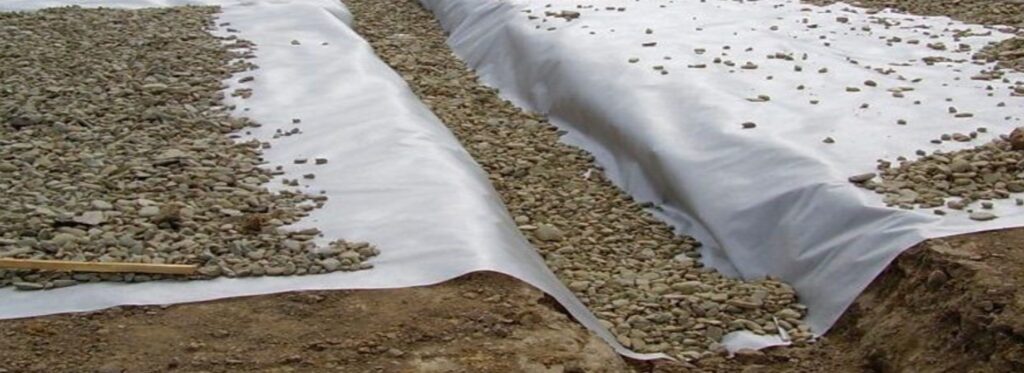
Non-woven geotextiles excel in filtration applications. Their three-dimensional pore structure allows water to pass while preventing soil migration. This reduces clogging risk and maintains long-term drainage efficiency.
Common filtration applications include:
- Subsurface drainage systems
- Retaining wall back drainage
- Riverbank and coastal protection
- Landfill leachate collection layers
Woven Geotextile Filtration Limitations
While woven geotextiles can perform filtration in coarse soils, their lower permeability and more uniform pore openings may increase clogging risk in fine-grained soils. This is a critical consideration in the woven vs non-woven geotextile decision.
Drainage Capability
Drainage performance is closely linked to filtration behavior. Non-woven geotextiles provide superior in-plane and cross-plane water flow, making them the preferred choice for drainage-related applications.
Woven geotextiles, by contrast, are not typically selected for drainage layers unless water flow demands are minimal.
Separation Function
Both woven and non-woven geotextiles are effective separation layers, preventing intermixing of subgrade soil and aggregate layers.
- Woven geotextiles are preferred when separation must also provide reinforcement.
- Non-woven geotextiles are preferred when separation must be combined with filtration and drainage.
Proper separation is a key factor in extending pavement service life.
Protection and Cushioning
Non-woven geotextiles provide superior cushioning and protection due to their thickness and flexibility. They are commonly used to protect geomembranes in ponds, reservoirs, and landfill liners.
Woven geotextiles offer limited protection and are not recommended where puncture resistance and cushioning are required.
Installation Considerations
Woven Geotextile Installation
- Requires relatively smooth subgrade preparation
- Must be installed under controlled tension
- Lower tolerance to sharp objects
Non-Woven Geotextile Installation
- Easily conforms to irregular surfaces
- High tolerance to installation damage
- Suitable for complex geometries and confined spaces
Installation conditions often influence the woven vs non-woven geotextile choice.
Durability and Environmental Resistance
Both woven and non-woven geotextiles are manufactured from polymers with excellent resistance to chemical attack, biological degradation, and moisture exposure. When buried and protected from UV exposure, both types can achieve service lives exceeding several decades.
Cost and Value Considerations
- Woven geotextiles are generally more cost-effective for reinforcement-focused applications
- Non-woven geotextiles may have higher unit costs but provide multiple functions simultaneously
Evaluating cost based on function rather than material price alone is essential when comparing woven vs non-woven geotextile solutions.
How to Choose Between Woven and Non-Woven Geotextile
The correct selection depends on project requirements rather than product category.
Select Woven Geotextile When:
- Tensile reinforcement is required
- Load distribution is critical
- Pavement or platform stabilization is needed
Select Non-Woven Geotextile When:
- Filtration and drainage are primary functions
- Soil retention is critical
- Geomembrane protection is required
This functional approach ensures optimal performance and durability.
Typical Engineering Applications
Road Construction
Woven geotextiles are commonly used for subgrade reinforcement, while non-woven geotextiles support drainage and filtration layers.
Retaining Walls
Non-woven geotextiles are installed behind walls for drainage, while woven geotextiles may be used beneath reinforced soil structures.
Erosion Control
Non-woven geotextiles dominate erosion control applications due to their filtration performance.
Conclusion
The decision between woven vs non-woven geotextile should always be based on engineering function, soil conditions, and performance requirements. Woven geotextiles excel in reinforcement and separation, while non-woven geotextiles provide superior filtration, drainage, and protection.
By understanding these differences and applying proper selection criteria, engineers and contractors can ensure long-term performance, cost efficiency, and structural reliability in geotechnical projects.