Introduction
In reinforced soil engineering, uniaxial geogrid is widely recognized as one of the most effective materials for retaining walls, reinforced slopes, steep embankments, and mechanically stabilized earth (MSE) systems. Despite its extensive use, a fundamental engineering question is still frequently asked by designers, contractors, and material buyers: what tensile direction is critical for uniaxial geogrid?
The answer lies in understanding the uniaxial geogrid tensile direction, which governs how the material carries load, controls deformation, and ensures long-term stability. Unlike other geogrid types, uniaxial geogrid is intentionally engineered to resist tensile forces primarily in one direction. This directional behavior is not a limitation; rather, it is the core reason why uniaxial geogrid performs exceptionally well in earth-retaining applications.
However, incorrect understanding or misalignment of the uniaxial geogrid tensile direction can lead to severe performance loss, excessive deformation, or even structural failure. This article provides a comprehensive, engineering-focused explanation of uniaxial geogrid tensile direction, supported by design logic, application examples, and industry standards.
What Is Uniaxial Geogrid?
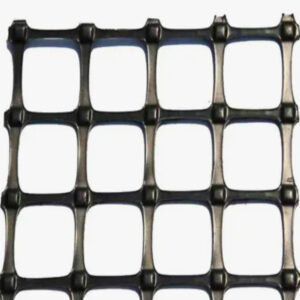
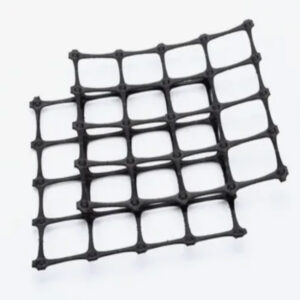
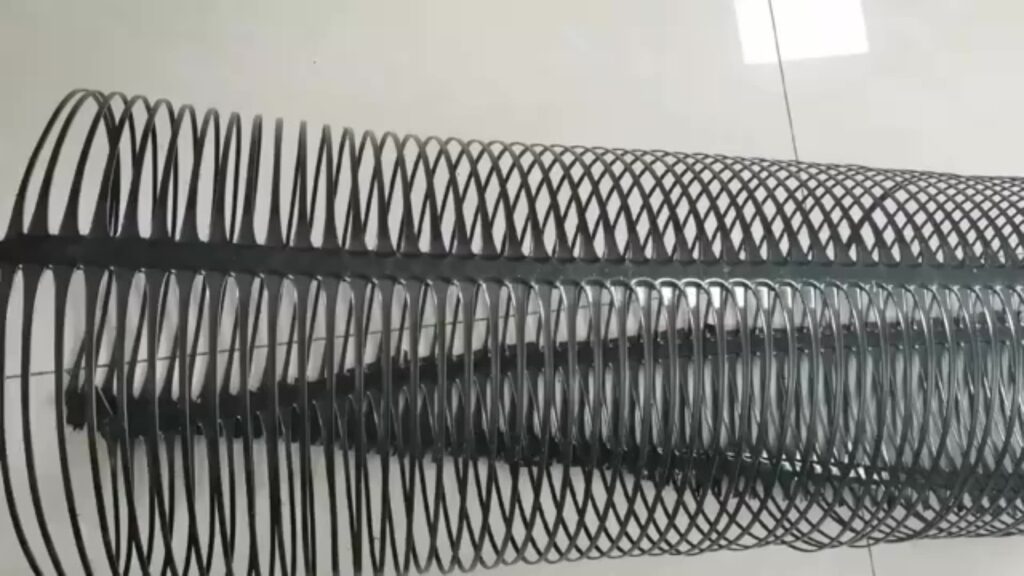
Uniaxial geogrid is a polymer-based geosynthetic reinforcement typically manufactured from high-density polyethylene (HDPE) or polypropylene (PP). The manufacturing process involves extruding a flat polymer sheet, punching a regular pattern of apertures, and then stretching the sheet predominantly in one direction.
This unidirectional stretching aligns polymer molecules along the stretch direction, resulting in high tensile strength, high modulus, and excellent creep resistance in that direction. The result is a geogrid with a clearly defined uniaxial geogrid tensile direction, which differentiates it from biaxial and triaxial geogrids.
Key Characteristics of Uniaxial Geogrid
- Very high tensile strength in one principal direction
- Low elongation at working loads
- Superior long-term creep resistance
- High junction efficiency
- Strong soil–geogrid interlock
These characteristics are fully mobilized only when the uniaxial geogrid tensile direction is correctly oriented in the structure.
Understanding Tensile Directions in Uniaxial Geogrid
Machine Direction (MD)
The machine direction (MD) is the direction in which the geogrid is stretched during manufacturing. For uniaxial geogrids, this direction carries the vast majority of tensile strength and stiffness.
When engineers specify tensile strength values for uniaxial geogrid, they are referring specifically to MD tensile strength. All long-term design considerations, including creep reduction factors and partial safety factors, are based on the machine direction.
Cross-Machine Direction (CMD)
The cross-machine direction (CMD) runs perpendicular to the MD. In uniaxial geogrids, CMD strength is intentionally low and is not designed to carry structural tensile loads. Its primary functions are maintaining aperture geometry and ensuring dimensional stability during handling and installation.
Understanding the distinction between MD and CMD is essential to understanding uniaxial geogrid tensile direction.
What Tensile Direction Is Critical for Uniaxial Geogrid?
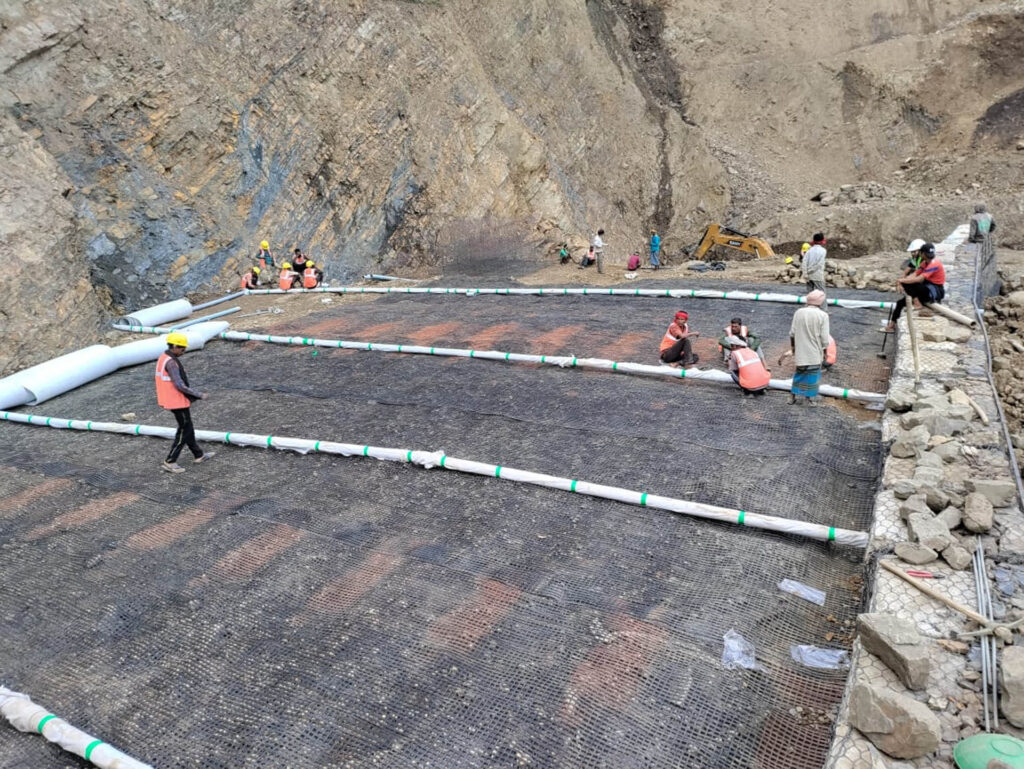
The critical tensile direction for uniaxial geogrid is unequivocally the machine direction (MD).
This means that uniaxial geogrid must be installed so that the machine direction aligns with the primary tensile forces generated within the reinforced soil mass. Only in this orientation can the geogrid mobilize its designed tensile capacity and perform its intended reinforcement function.
In practical engineering terms:
- Tensile loads must act parallel to the MD ribs
- MD must extend into the reinforced soil zone
- CMD must never be relied upon for tensile resistance
Failure to respect the uniaxial geogrid tensile direction is one of the most critical errors in reinforced soil construction.
Why the Machine Direction Is Structurally Critical
Resistance to Lateral Earth Pressure
In retaining walls and reinforced slopes, soil tends to move outward due to gravity, surcharge loads, traffic, and seismic effects. This movement generates tensile forces that must be resisted by reinforcement layers.
Uniaxial geogrid resists these forces effectively only when they act along the machine direction. The uniaxial geogrid tensile direction therefore directly controls wall deformation, stability, and service life.
Long-Term Creep Performance
Uniaxial geogrids are engineered and tested for sustained tensile loading in the MD. Long-term creep tests and reduction factors apply exclusively to the machine direction.
If loads are applied in the CMD, creep resistance is insufficient, potentially leading to progressive deformation or structural distress over time.
Application-Specific Tensile Direction Requirements
Retaining Walls
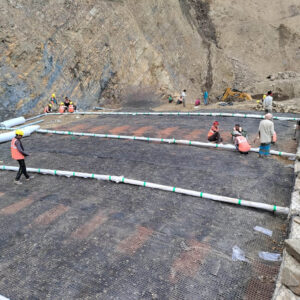
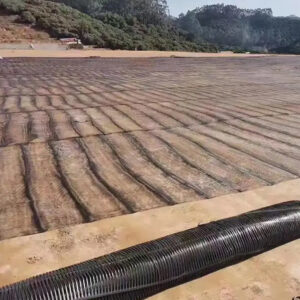
In mechanically stabilized earth retaining walls, uniaxial geogrid tensile direction must be perpendicular to the wall face.
- MD extends horizontally into the backfill
- Tensile forces act away from the wall
- CMD runs parallel to the wall face
This configuration allows the geogrid to resist lateral earth pressure efficiently.
Reinforced Slopes
For reinforced slopes, uniaxial geogrid is installed so that the MD aligns with the direction of potential soil movement along the critical slip surface.
Correct control of uniaxial geogrid tensile direction is essential to achieving the required factor of safety.
Embankments on Soft Ground
In embankments, uniaxial geogrid helps resist lateral spreading and tensile strain at the base of the fill. The MD must align with the direction of tensile stress development.
Comparison With Other Geogrid Types
Understanding uniaxial geogrid tensile direction becomes clearer when compared with alternative geogrid products.
Uniaxial Geogrid
- Tensile strength concentrated in one direction
- Orientation-sensitive
- Ideal for retaining walls and slopes
Biaxial Geogrid
- Tensile strength in two perpendicular directions
- Less orientation-sensitive
- Commonly used for road base reinforcement
Triaxial Geogrid
- Multi-directional tensile resistance
- Orientation-independent
- Designed for load distribution under traffic
This comparison highlights why uniaxial geogrid tensile direction must be treated as a primary design parameter.
Design Considerations Related to Tensile Direction
Design Tensile Strength
All published tensile strength values for uniaxial geogrid refer to MD properties. Designers must ensure that calculated tensile forces align with the uniaxial geogrid tensile direction.
Pullout Resistance
Correct MD alignment maximizes soil–geogrid interaction and pullout resistance, which is essential for internal stability.
Junction Strength and Load Transfer
Junctions are optimized to transfer load efficiently along MD ribs. Misalignment significantly reduces load transfer efficiency.
Installation Errors and Engineering Consequences
Common Installation Errors
- Installing geogrid with MD parallel to the wall face
- Misidentifying roll direction
- Treating uniaxial geogrid as biaxial
Consequences
- Severe loss of tensile capacity
- Increased deformation
- Reduced safety margins
- Potential long-term failure
These risks clearly demonstrate the importance of respecting the uniaxial geogrid tensile direction.
Standards and Engineering Guidelines
Major international standards consistently emphasize correct tensile direction for uniaxial geogrids:
- FHWA MSE Wall Design Guidelines
- AASHTO LRFD Bridge Design Specifications
- BS 8006 Reinforced Soil Code of Practice
- EN ISO Geosynthetics Standards
All confirm that uniaxial geogrid tensile direction must align with primary tensile forces.
Economic and Performance Benefits of Correct Orientation
Correct control of uniaxial geogrid tensile direction delivers:
- Higher structural efficiency
- Reduced reinforcement quantity
- Improved long-term performance
- Lower maintenance costs
Incorrect orientation negates these benefits regardless of material quality.
Conclusion
The answer to what tensile direction is critical for uniaxial geogrid is technically unambiguous: the machine direction is the only direction designed to resist structural tensile loads.
Uniaxial geogrid tensile direction must always be aligned with the primary stresses in the reinforced soil mass. Whether used in retaining walls, reinforced slopes, or embankments, correct orientation is fundamental to safety, durability, and cost-effective geotechnical design.
For engineers, contractors, and professional buyers, understanding and applying this principle is not optional—it is the foundation of successful uniaxial geogrid application. Contact us now to get a quotation of uniaxial geogrid.