How Does Uniaxial Geogrid Reinforce Retaining Walls?
Introduction
“How does uniaxial geogrid reinforce retaining walls?” is one of the most frequently asked questions in modern geotechnical and civil engineering. As infrastructure projects become larger, taller, and more complex, traditional gravity and reinforced concrete retaining walls are often no longer the most economical or practical solution. Reinforced soil retaining walls using uniaxial geogrid have emerged as a proven, reliable, and cost-effective alternative.
Uniaxial geogrid is specifically engineered to resist tensile forces in one dominant direction, making it ideal for retaining wall applications where lateral earth pressure is the primary load. When properly designed and installed, uniaxial geogrid transforms weak soil into a stable, load-bearing composite structure.
This article provides an in-depth technical explanation of how does uniaxial geogrid reinforce retaining walls, covering reinforcement mechanisms, soil–geogrid interaction, design principles, construction methods, performance advantages, and real-world engineering applications.
1. Understanding Uniaxial Geogrid
1.1 What Is Uniaxial Geogrid?
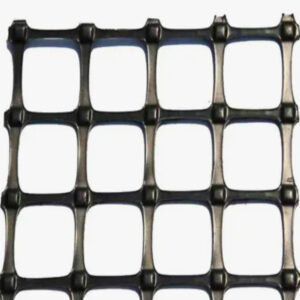
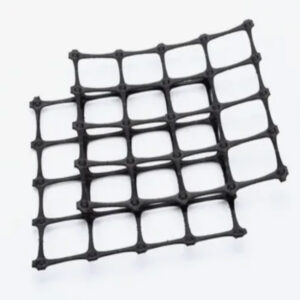
Uniaxial geogrid is a type of geosynthetic material manufactured from high-density polyethylene (HDPE) or polypropylene (PP). It is produced through an extrusion and stretching process that aligns polymer molecules in one primary direction, resulting in extremely high tensile strength along that axis.
Key characteristics include:
- High tensile strength in the longitudinal direction
- Excellent long-term creep resistance
- Open aperture structure for soil interlock
- Long service life in buried conditions
Because of these properties, uniaxial geogrid is widely used in retaining walls, steep slopes, embankments, and reinforced soil structures.
1.2 Difference Between Uniaxial and Other Geogrids
Unlike biaxial or triaxial geogrids, uniaxial geogrid is optimized for applications where loads act predominantly in one direction. In retaining walls, lateral earth pressure pushes horizontally against the wall face, making uniaxial geogrid the most efficient reinforcement choice.
2. Why Retaining Walls Require Reinforcement
2.1 Earth Pressure Acting on Retaining Walls
Retaining walls are subjected to multiple forces, including:
- Active earth pressure
- Surcharge loads from traffic or structures
- Seismic loads in earthquake-prone regions
- Hydrostatic pressure due to poor drainage
Without reinforcement, these forces can cause wall failure through sliding, overturning, or excessive deformation.
2.2 Limitations of Conventional Retaining Wall Systems
Traditional concrete retaining walls often involve:
- Large foundations
- High material consumption
- Long construction periods
- High costs for tall walls
Reinforced soil retaining walls using uniaxial geogrid overcome these limitations by mobilizing soil strength rather than resisting earth pressure solely with rigid structural elements.
3. How Does Uniaxial Geogrid Reinforce Retaining Walls?
The answer to “how does uniaxial geogrid reinforce retaining walls” lies in the interaction between soil and geogrid, where tensile reinforcement, friction, and mechanical interlock work together to stabilize the structure.
3.1 Tensile Reinforcement Mechanism
Soil is strong in compression but weak in tension. When lateral earth pressure causes soil to move outward:
- Tensile forces develop within the soil mass
- Uniaxial geogrid absorbs these tensile forces
- Lateral deformation is restrained
The geogrid effectively replaces soil’s lack of tensile strength with high-performance polymer reinforcement.
3.2 Soil–Geogrid Interlock Mechanism
The open apertures of uniaxial geogrid allow soil particles to pass through and lock against the ribs. This creates:
- Passive resistance
- Frictional resistance
- Bearing resistance
The stronger the interlock, the more efficiently tensile forces are transferred from soil to geogrid.
3.3 Formation of a Reinforced Soil Block
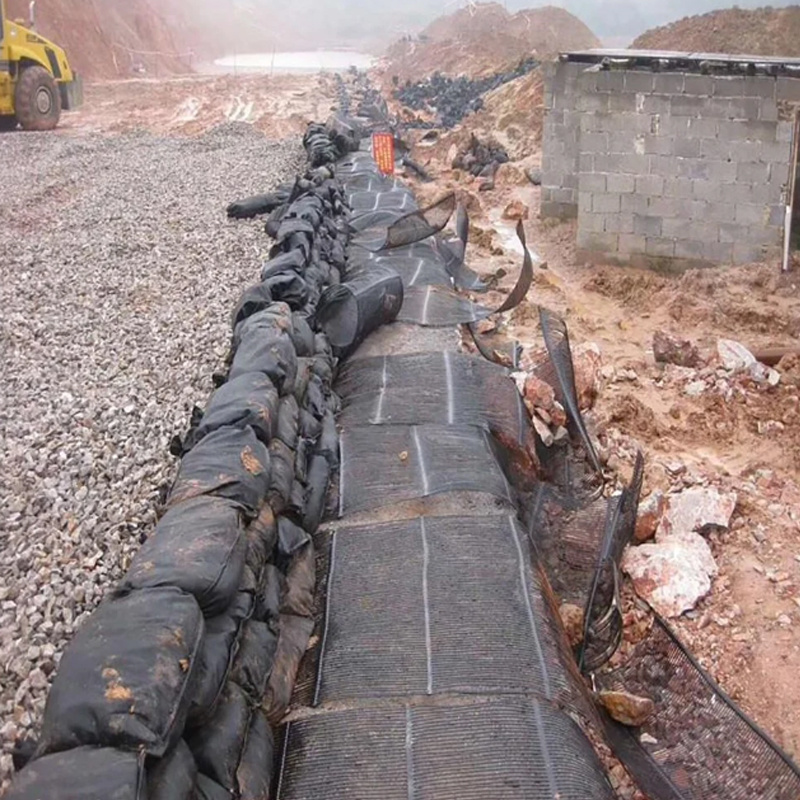
Multiple layers of uniaxial geogrid are placed horizontally within compacted backfill. Together, they create a reinforced soil mass that:
- Acts as a single gravity structure
- Resists earth pressure through mass and tensile strength
- Transfers loads deeper into stable soil zones
The retaining wall facing mainly serves as a confinement and erosion protection element.
4. Structural Role of Uniaxial Geogrid in Retaining Walls
4.1 Internal Stability Improvement
Uniaxial geogrid enhances internal stability by preventing:
- Tensile rupture
- Pullout failure
- Excessive deformation
Proper spacing and strength selection are critical to maintaining internal stability.
4.2 External Stability Enhancement
By extending into stable soil, uniaxial geogrid improves:
- Sliding resistance
- Overturning resistance
- Bearing capacity
This allows reinforced retaining walls to be built on weaker foundations than traditional walls.
4.3 Reduction of Earth Pressure on the Wall Face
The reinforced soil mass reduces active earth pressure acting on the wall face. As a result:
- Wall facings can be thinner and lighter
- Construction costs are reduced
- A wider range of facing types can be used
5. Design Principles for Uniaxial Geogrid Retaining Walls
5.1 Geogrid Strength Selection
Design tensile strength must consider:
- Ultimate tensile strength
- Creep reduction factors
- Installation damage factors
- Environmental durability factors
Long-term design strength ensures service life performance.
5.2 Reinforcement Length Design
Typical reinforcement length ranges from:
- 0.6H to 0.8H (H = wall height)
Adequate length ensures sufficient anchorage and pullout resistance.
5.3 Vertical Spacing of Geogrid Layers
Vertical spacing usually varies between:
- 0.4 m and 0.8 m
Closer spacing provides greater stability, especially for tall retaining walls.
5.4 Connection to Wall Facing
Connections must:
- Transfer tensile loads safely
- Prevent slippage or rupture
- Match the facing system design
Common facing systems include modular blocks, precast concrete panels, and wrapped geotextile facings.
6. Construction Process of Uniaxial Geogrid Retaining Walls
6.1 Site Preparation
- Foundation leveling
- Drainage installation
- Base compaction
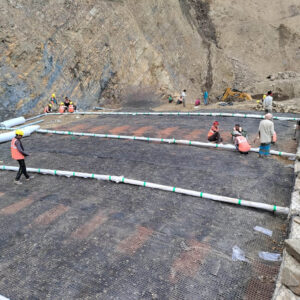
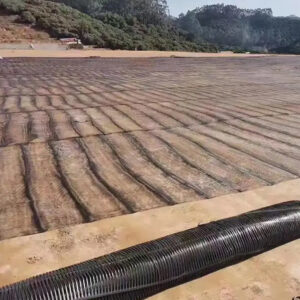
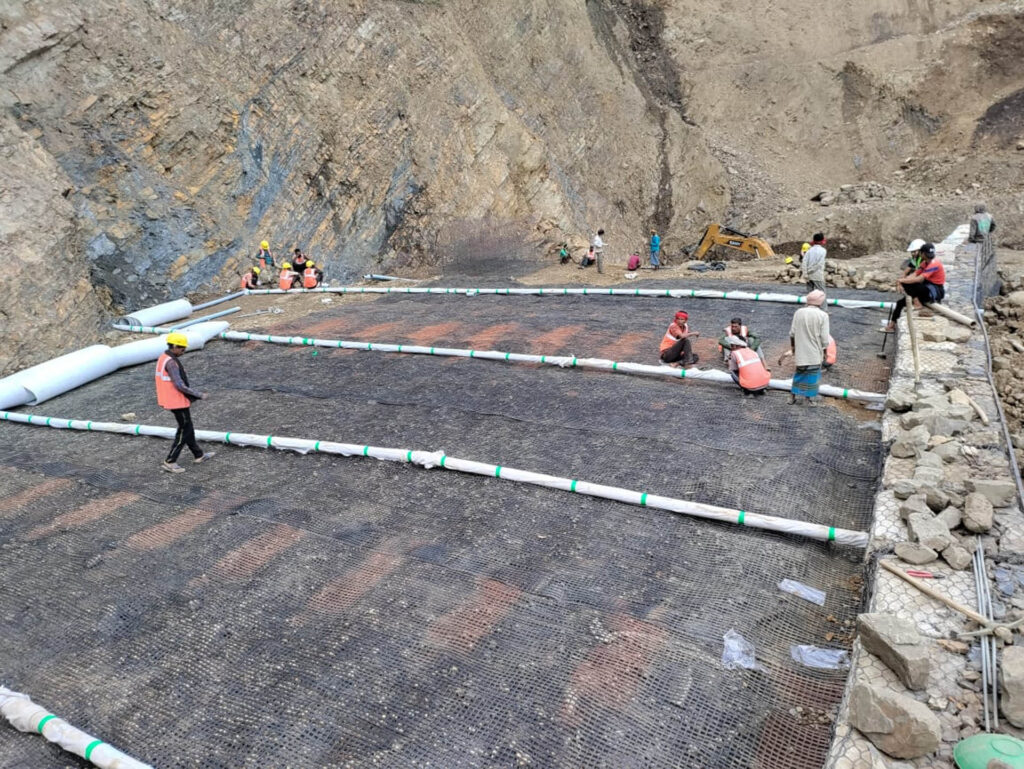
6.2 Geogrid Placement
- Laid horizontally without wrinkles
- Proper tensioning
- Correct alignment perpendicular to wall face
6.3 Backfill Placement and Compaction
- Free-draining granular soil preferred
- Layer-by-layer compaction
- Avoid heavy equipment directly on geogrid
7. Advantages of Using Uniaxial Geogrid for Retaining Walls
7.1 Engineering Advantages
- High tensile capacity
- Long-term dimensional stability
- Excellent creep resistance
7.2 Economic Advantages
- Lower construction cost
- Reduced concrete usage
- Faster project completion
7.3 Environmental Advantages
- Lower carbon footprint
- Reduced excavation
- Better adaptability to ground movement
8. Typical Applications
- Highway retaining walls
- Bridge abutments
- Industrial storage yards
- Port and harbor structures
- Mining and energy projects
9. Common Failure Modes and Prevention
9.1 Pullout Failure
Prevented by sufficient reinforcement length and good compaction.
9.2 Tensile Rupture
Prevented by proper strength selection and design factors.
9.3 Excessive Deformation
Prevented by adequate spacing and quality backfill.
10. Conclusion
Understanding how does uniaxial geogrid reinforce retaining walls is essential for modern geotechnical engineering. Through tensile reinforcement, soil interlock, and load redistribution, uniaxial geogrid enables the construction of stable, economical, and durable retaining wall systems.
When properly designed and installed, uniaxial geogrid reinforced retaining walls outperform traditional systems in terms of cost, flexibility, and long-term performance. As infrastructure development continues worldwide, uniaxial geogrid will remain a cornerstone solution in retaining wall engineering. Contact us now to get a solution of retaining wall with uniaxial geogrid.